
© 2026 J&P DESIGN
Finca Gardens in Mallorca
To own a finca in Mallorca is a decision about how to live — more quietly, more rooted, closer to the island as it actually is. The garden should continue that decision rather than contradict it.
The correction we are most often asked to make is a garden that was imported: a continental scheme set down on Mallorcan ground, at odds with the climate every summer and never quite belonging. The alternative is not less garden. It is a garden that appears to have grown here.
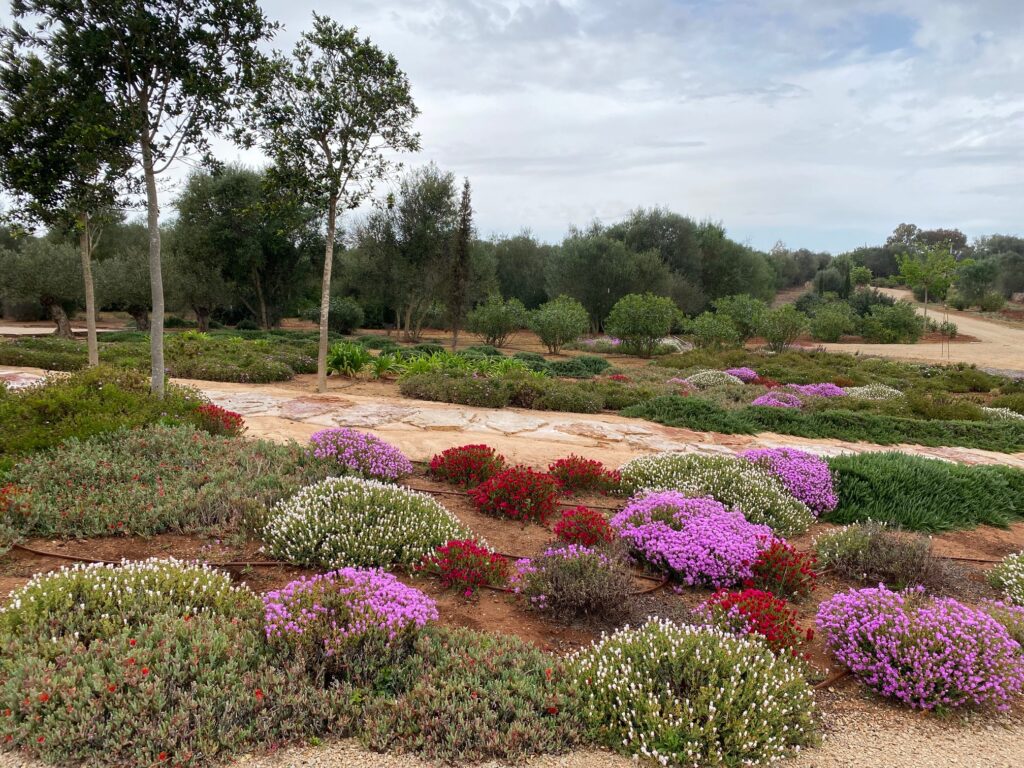
J&P Design has been based in the southeast of the island since 2008, and most of our work is on rural property. We know these soils, these winds and these plants because we work in them every week of the year.
What a finca garden asks for
The boundary should be permeable. On rural land a garden should not stop at a line. It should move gradually from designed planting, through managed vegetation, into the garrigue beyond. Resolving that transition is most of the design.
The land already holds its best material. Old olive, carob, almond and fig trees. Dry-stone walls and terraces built generations ago. These are worth more than anything that could be added, and the work is to build around them rather than through them.
The water is often already yours. Many fincas have a well or a cistern standing unused. Bringing it into the irrigation is what allows a garden here to be independent — and in a season when the municipality restricts the mains supply, that independence is the whole difference.
Scale changes the question. On a large property the decision is not what to plant. It is what becomes garden and what remains landscape.
A garden that adds to the estate
A finca is bought for its setting as much as for its walls. The house can be restored in a year; the landscape around it cannot be bought ready-made. It has to be planned, planted and given time.
That is what makes a garden of this kind an addition to the property rather than a cost against it. Restored terraces, mature olive trees given room, a planting scheme that has closed and settled — these are not decoration. They are part of what the estate is, and they will still be there long after everything inside the house has been replaced.
The water question
Mallorca’s reserves fell to thirty-nine per cent in July, and the demand units covering the southeast — Migjorn and Manacor-Felanitx — now stand at alert level. Several municipalities already prohibit the watering of gardens from the mains supply.
We design finca gardens that do not depend on it: drought-tolerant planting in place of lawn, drip irrigation in place of sprinklers, mulch throughout, and your own well or cistern brought into the system where one exists. The consequence is straightforward — when your neighbour may not water, your garden continues.
What we do
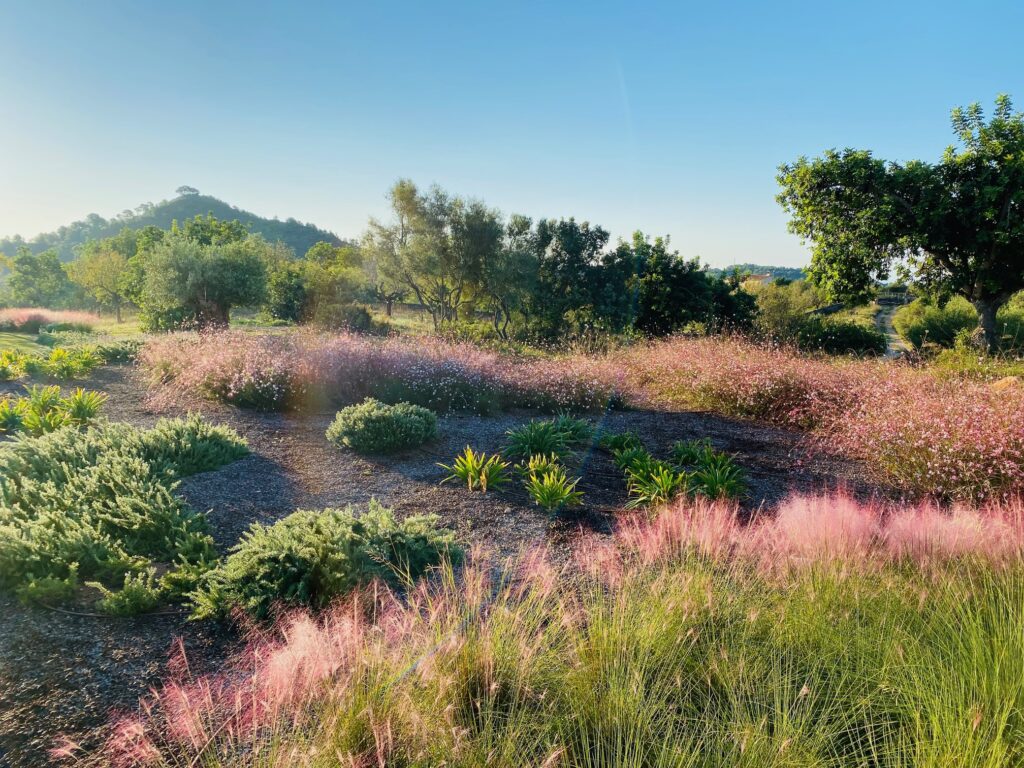
Site analysis across the whole property. Naturalistic planting drawn from the local palette — cistus, rosemary, lavender, lentisc, the ornamental grasses of the garrigue. Dry-stone terracing built as it has always been built here. Irrigation with well or cistern integration and intelligent control. Pool surrounds set into the terrain rather than upon it. Orchard, vegetable garden or olive grove brought into the composition instead of fenced away from it. And continuing care for a house lived in part of the year.
A garden you walk into
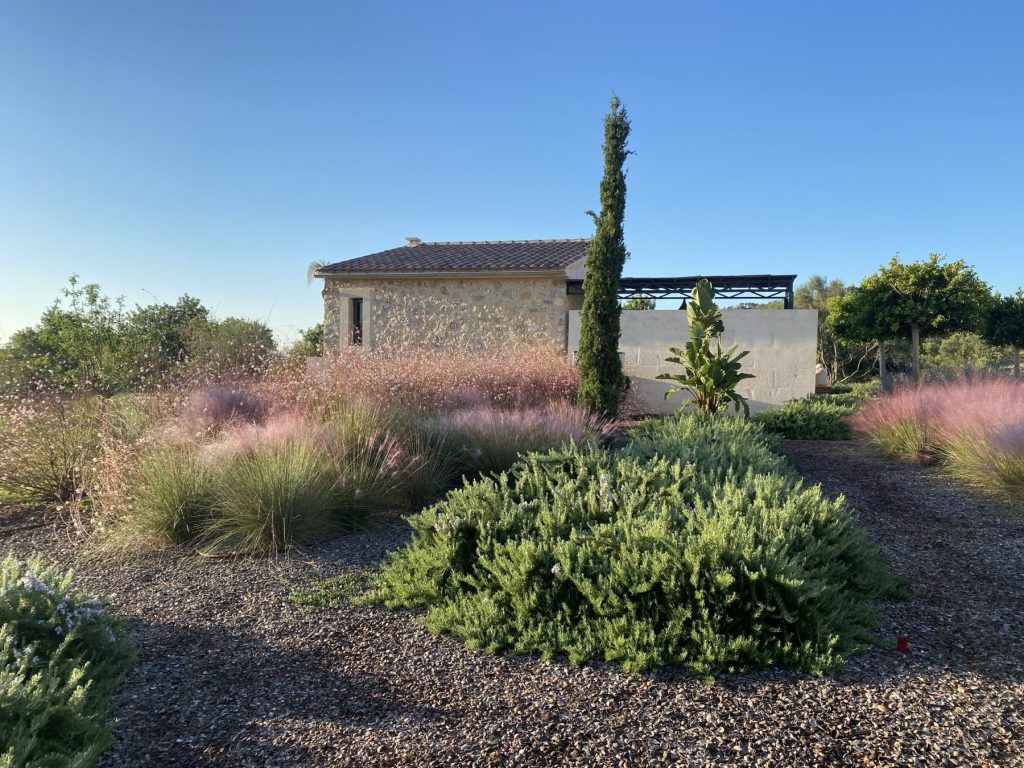
Here is the difference, and it decides everything about the design. A villa garden is enjoyed from the terrace: you look at it. A finca garden is enjoyed from inside it. You walk in, and the place closes around you.
What you notice first is structure — the way the ground rises, where a wall holds a level, how a mass of rosemary gives way to open gravel and then to the wild. You feel it before you could describe it.
Then colour, which on a finca is never loud. Silver and grey-green through most of the year, the gold of the marès stone, cistus in white and mauve for a few weeks in spring, the pink haze of the grasses at the end of summer.
And then scent, which is the part people remember and nobody expects. Rosemary and wild thyme when you brush past them. The resin of cistus in the heat of the afternoon. Fennel, myrtle, warm pine. Wet earth after the first rain of September.
This is what we mean when we say a finca garden should feel of its place. Not that it looks rural — that it feels like nature, arranged just enough that you can live in it.
More about our work
See our wider approach to garden and landscape design in Mallorca, and our page on villa gardens.
Finca projects we have built
The work is easiest to understand through the properties themselves. The finca garden in Santanyí shows what is possible across more than 50,000 m². The garden at Cala Llombards belongs to a fully self-sufficient new build. And Finca Rosmarin is composed around a single plant — the rosemary that gave the house its name.
More of our work is in projects.
Paths, steps and walls are the frame the planting is set against. What we build them from — and why a garden path as a rule needs no building licence — is set out under Mallorcan natural stone in the garden.
Where the water in Mallorca actually stands — reserves, alert levels and what the town halls already prohibit — is set out with figures and a date under water and gardens in Mallorca.
How a garden is built to come through a Mallorcan summer on very little water — the planting, the lawn question and the ground cover — is set out under drought-tolerant gardens.
We work across the island. On particular areas: Santanyí and Andratx and Port d’Andratx.
We work across the island. On particular areas: Santanyí, Andratx and Port d’Andratx, Alaró and Artà.
Just bought a property here? See a garden for your new home in Mallorca — what to expect on water, permits and timing.
A conversation on your land
Every project begins on site. We walk the property with you, look at what is already there, and tell you plainly what we believe is worth doing. Without obligation.


