
© 2026 J&P DESIGN
Drought-Tolerant Gardens in Mallorca
Most gardens in Mallorca are built to a northern European idea and then kept alive against the island. Lawn where the ground wants scrub, bedding that needs replacing every year, and an irrigation system running long enough to hide the mismatch.
We build the other kind. A garden designed from the start around how much water there is — which turns out not to be a compromise, but the only version of a Mallorcan garden that looks right in August.
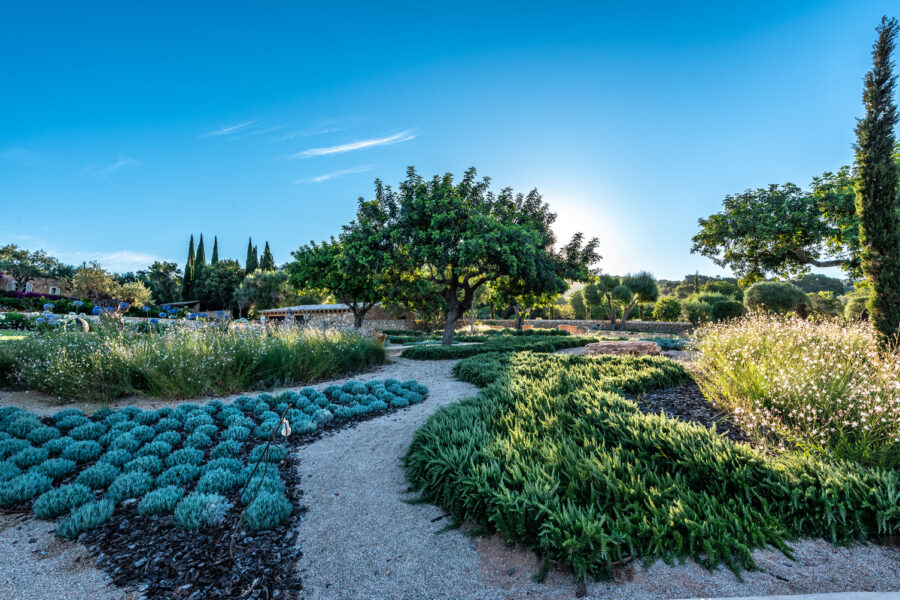
No lawn. And that is not a sacrifice.
A lawn is the single largest consumer of water in almost any garden here, and in return it gives you a green rectangle that looks its worst precisely when you are using the garden most.
What replaces it is not gravel. It is planting: drifts of grasses that move in the wind, rosemary and cistus in low mounds, gaura and tulbaghia flowering through the heat, junipers holding the shape in winter. The eye is given more to look at, not less — and the ground between them is covered, not bare.
What grows here without being fought
The plant list is the design. Everything else follows from it.
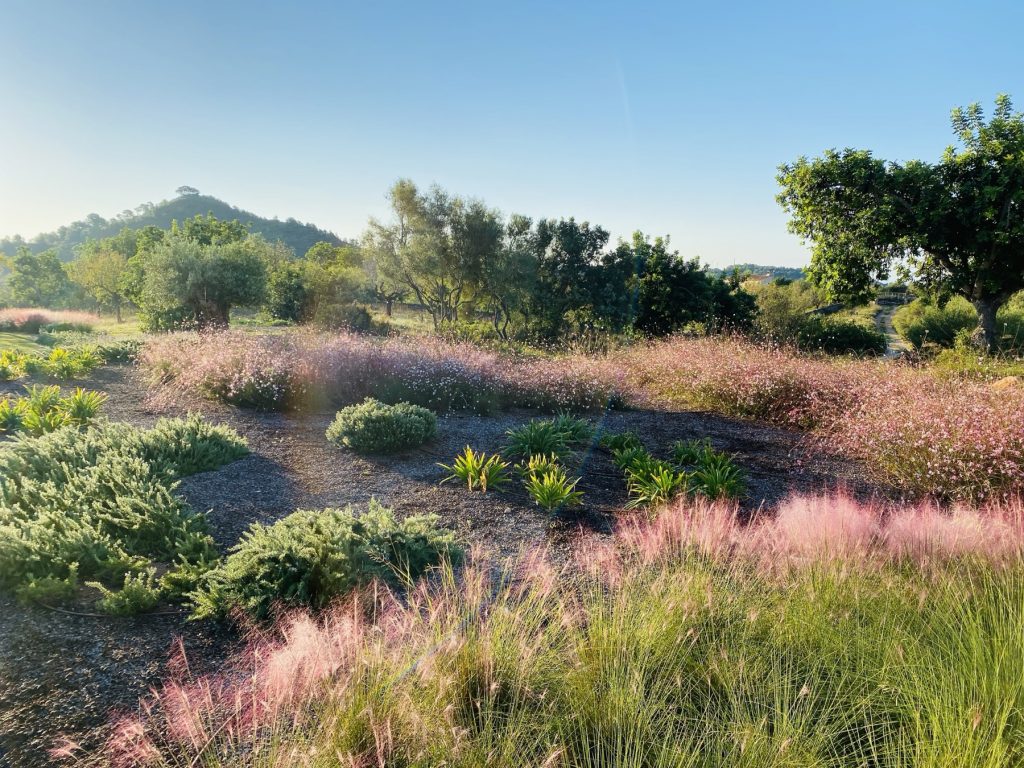
We work with species for which a Mallorcan summer is normal rather than an emergency: Rosmarinus officinalis, Cistus, Perovskia, Westringia, Juniperus, Stipa tenuissima, Muhlenbergia capillaris, Gaura lindheimeri, Tulbaghia violacea, together with olive, carob and almond as the structure above them.
By the third year most of this planting needs very little. That is the point at which a garden stops being a running cost and starts being an asset — one of the few parts of a property that is genuinely worth more each year rather than less.
If a lawn is genuinely wanted
Sometimes there are children, or a stretch of green really is the right answer for one part of the garden. In that case we do not argue. We change the species.
We use bermuda grass — Cynodon dactylon, known on the island as grama. Under prolonged drought it goes dormant: the blade browns off, the plant does not die, and it greens again within days of the first real water. Compared with the cool-season lawns usually laid here, that is the difference between a lawn that survives a restriction and one that has to be relaid after it.
The rule we apply is simple: the lawn is sized to the use it will get, not to the space available. A generous patch by the terrace where people actually sit. Not a green field crossing the whole plot because there was nothing else planned for it.
The ground between the plants
Bare soil loses water to the air before the roots ever reach it, and it grows weeds. Every square metre we plant is covered.
Where the planting is close and naturalistic we use almond shell, a by-product of the island’s own crop: it holds moisture, its open structure lets the soil breathe instead of compacting it the way pressed bark or a membrane does, and its warm tone makes the silver and mauve of the planting read more strongly. Where a surface has to be walked on, or read as a clearing between planted areas, we use local gravel graded to the setting.
What we avoid is the third option — gravel over plastic, with a few isolated shrubs punched through it. It saves water and costs everything else: it bakes, it reflects heat back at the house in the evening, and it never improves.
The other half: irrigation dosed per plant
Choosing the right plants only works if the water reaches them correctly while they establish, and sparingly afterwards.
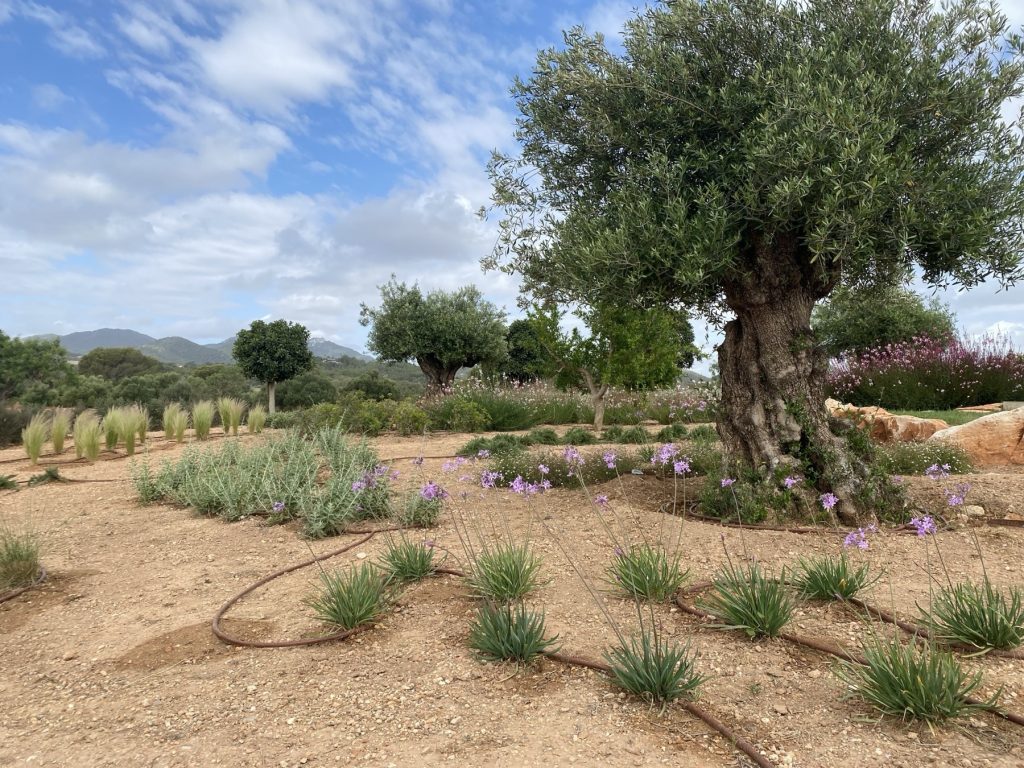
Every emitter sits at the plant it serves. Pressure-compensating emitters deliver the same volume at the top of a slope as at the bottom. Circuits are separated by water requirement rather than by position, so that a single run time does not drown one bed while starving another. And the controller reads the weather, skipping a cycle after rain and detecting a burst line by its flow rate.
The detail is set out on our page on irrigation systems.
What the garden looks like in February
This is the test most gardens fail, and the reason we design this way.
A garden built on annual colour and lawn has nothing to show for six months of the year. A garden built on structure has everything: the grasses hold their form long after they have gone straw-coloured, rosemary and juniper stay solid and green, the olives carry the height, and the stone — paths, steps, retaining walls — draws the whole thing together. Then the almond blossom arrives in February and the year starts again.
If you are here in winter, this matters more than anything on this page.
What it costs and what it saves
A drought-tolerant garden is not more expensive to build than a conventional one. Ground preparation and mulch cost a little more; the lawn and the equipment that keeps it alive fall away.
The difference shows in what follows: considerably less water, no weekly mowing, far fewer replacement plants. Over ten years it is the cheaper garden — and the only one untouched by whatever restrictions come next. What is already prohibited in some municipalities, and why the classification is slow to lift, we have set out under water and gardens in Mallorca.
More about our work
For an overview see garden design in Mallorca. For the planting style in more depth, our page on the Mediterranean garden. For country properties, finca gardens, and for the paths, steps and walls that hold it all together, Mallorcan natural stone.
We work across the island. On particular areas: Santanyí and Andratx and Port d’Andratx.
We work across the island. On particular areas: Santanyí, Andratx and Port d’Andratx, Alaró and Artà.
Just bought a property here? See a garden for your new home in Mallorca — what to expect on water, permits and timing.
Let us look at your land
We will come and see the site, and tell you what will grow there and on how much water. J&P Design, landscape architects in Santanyí in the south-east of Mallorca since 2008 — in the Migjorn unit, one of the driest on the island.


