
© 2026 J&P DESIGN
Irrigation Systems in Mallorca
Mallorca receives no meaningful rainfall between May and September, and July and August regularly pass thirty-five degrees. No garden here comes through that without a well-made irrigation system — and a poorly made one will cost more over its life, in water, in replaced plants and in repairs, than getting it right at the outset.
We design and install irrigation as part of every garden we build, and as a separate commission for existing gardens whose systems no longer serve them.
Why the design decides everything
An irrigation system is not a product taken off a shelf. The difference between a good one and a poor one is invisible at first. It shows after two summers: in how the planting holds through August, in what appears on the water bill, and in how often somebody has to come and repair something.
A system laid without reference to the planting plan overwaters one part of the garden and underwaters another. Cheap components do not last long in Mallorcan water. A controller without weather compensation waters to a fixed schedule whether it rained last night or not.
We design the irrigation alongside the planting rather than after it. Every emitter sits where the plant it serves sits. Every zone is calibrated to the water requirement of its planting type.
How a system is put together
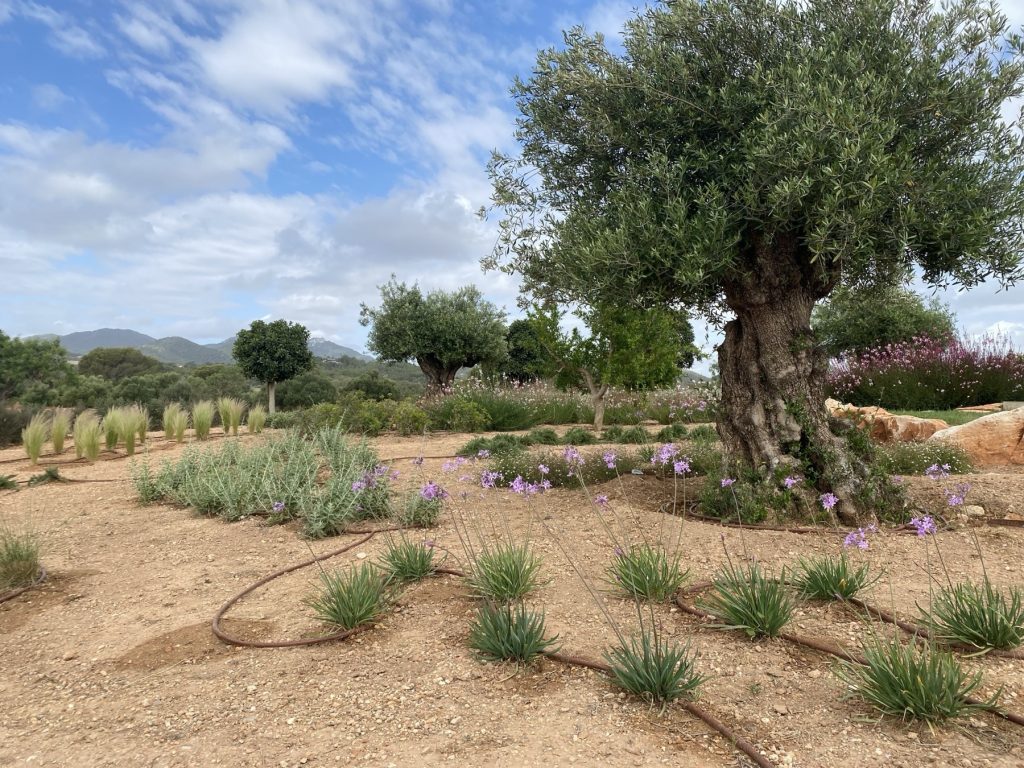
Pressure-compensating emitters. On sloping ground — which in Mallorca means most ground — a simple emitter delivers considerably more water at the bottom than at the top, because pressure rises with the drop. Pressure-compensating emitters deliver the same volume regardless of pressure or height.
Dosing per plant. Emitters come in different flow rates. A young carob does not want what a cistus wants. We specify the number and rate for each plant rather than running the same thing everywhere.
Hydrozoning. Circuits are separated by water requirement, not by position in the garden. Without that, run time is dictated by the thirstiest plant on the circuit and everything else is drowned.
Filtration and pressure regulation at the source. Mallorcan water is hard, and well water often carries suspended solids. Without proper filtration, emitters block — the single most common reason existing systems stop working.
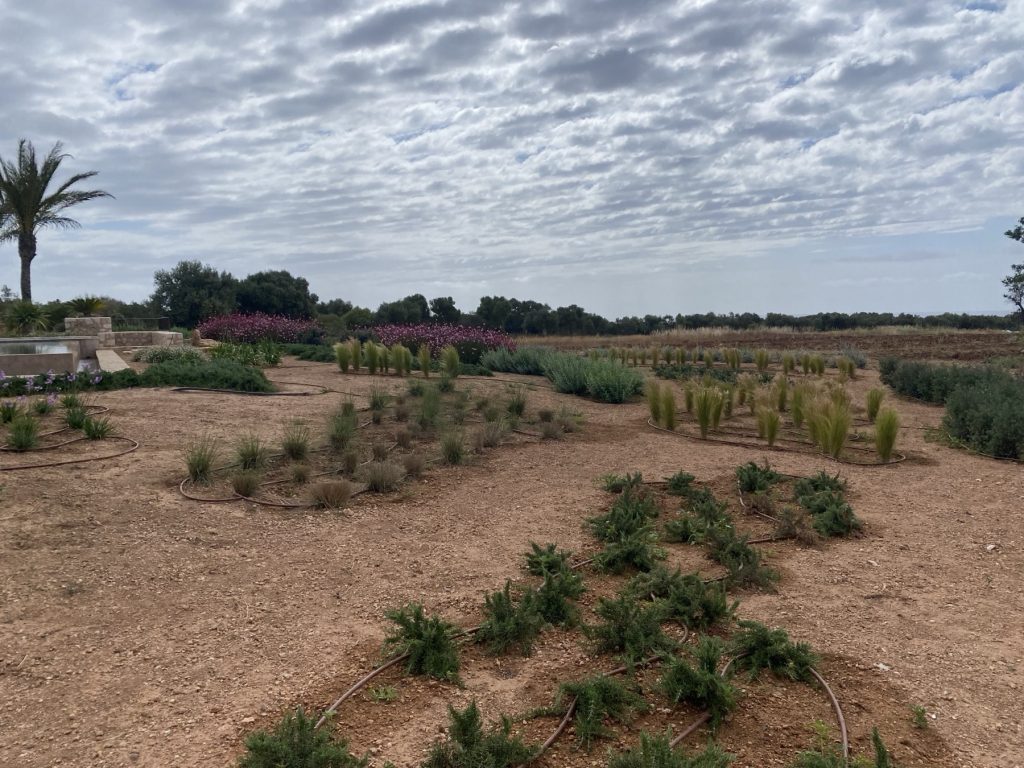
Inline dripline beneath mulch. For continuous planting, pipe with emitters built in at fixed spacing, laid under the mulch. Invisible in operation and almost nothing lost to the air.
Weather-compensating control with remote access. The system waters on demand rather than on schedule, and you can see and adjust it from anywhere.
Sensors and leak detection. Soil moisture and flow sensors report when something is wrong. For a house standing empty for months, that is the difference between a failed emitter and a lost season.
The controller we work with: Hunter Hydrawise
We run our systems on Hunter Hydrawise. This is not a matter of taste. It is a decision in favour of a system proven in professional use and one we can look after remotely — including when nobody is at the house.
The system reads the weather. The controller draws data from the nearest weather stations — rainfall, temperature, humidity, wind — and calculates the real rate of evaporation from it. If it rained in the night, the morning cycle is skipped. If a week of heat is coming, watering is brought forward. The programme adapts without anyone having to be there to change it.
You can see your garden from your phone. Every zone can be checked, paused or run by hand from London, Zurich or Hamburg. An owner who does not see the house for months in winter still knows that the young olives were watered at six on Tuesday morning.
And it tells you when something breaks. A burst pipe, or a valve that no longer closes, gives itself away through a flow rate that does not match the programme. The system shuts that zone down and sends a message — before the cistern has emptied. It is the reason we no longer fit simple time clocks.
The manufacturer puts the saving from controllers of this kind at up to fifty per cent. That figure refers to lawns under sprinklers. We apply the same intelligence to drip irrigation, in a garden already designed to use little. The gain here is no longer in the large number but in the precision — and in knowing the system still works properly in August, when you are not there.
Our irrigation services
Complete design and installation for new gardens and for full replacements — specification, supply, installation, commissioning and handover.
Assessment of an existing system. We survey what is there, identify what is failing, and tell you whether a new controller is enough or whether more is needed.
Smart controller retrofit. The single most effective change available on an existing system: weather-responsive, remotely managed, and installed without rebuilding anything.
Annual maintenance. Filter cleaning, emitter inspection, pressure checks and seasonal reprogramming.
Well and cistern integration. Many fincas have water sources standing unused. Bringing them into the system reduces running costs — and, in a year when the municipality restricts the mains supply, it is what allows a garden to be watered at all.
Water in Mallorca is no longer a background question
Reserves fell to thirty-nine per cent in July, and the demand units covering the southeast — Migjorn and Manacor-Felanitx — stand at alert level. Several municipalities already prohibit watering gardens from the mains.
A garden that does not depend on mains water is unaffected by those restrictions. That is not an environmental argument; it is simply what follows from how the system was designed.
Almond shell rather than imported bark
Over the drip lines we lay almond shell rather than imported bark mulch — a by-product of Mallorcan agriculture that this island produces in quantity every season.
The layer holds moisture in the soil instead of losing it to the afternoon sun, so the same volume of water goes considerably further. It keeps the ground cooler, which matters to roots in August. And it suppresses the weeds that would otherwise compete for exactly that water.
What matters most is something many coverings fail to do: almond shell lets the soil breathe. Its coarse, open structure allows air and water through instead of compacting. A pressed mulch blanket — or worse, a plastic membrane beneath it — suffocates the ground; the roots get no oxygen, and what was intended as protection becomes the problem. A natural material that holds moisture and still stays permeable is not easy to find.
And then the part one does not expect: almond shell makes the planting look better. Its warm, neutral tone works like the mount around a picture — the silver-grey of the rosemary, the mauve of the perovskia, the pink of the grasses all read more strongly against it. On bare earth or dark bark, the same colours lose their force.
It also belongs here. Its colour and grain settle into a Mallorcan landscape in a way that imported northern European bark never does.
Even the tap is a decision
At the visible end of an irrigation system there is almost always a detail nobody thinks about: the tap you screw the hose onto. In most gardens it is whichever one the fitter happened to have in the van. Plastic, or chromed sheet metal — stiff by the third summer, dripping by the fifth.
We fit taps in brass. Not only because they still work after twenty years, but because they settle into the garden. Chromed metal catches the light and pulls the eye — in a border, the tap is the first thing you see. Brass does the opposite: it loses its factory shine, takes on a quiet dark patina, and steps back until it belongs to the stone it is mounted on.
That is the real reason. A garden will not carry a fitting that is louder than the planting in front of it.
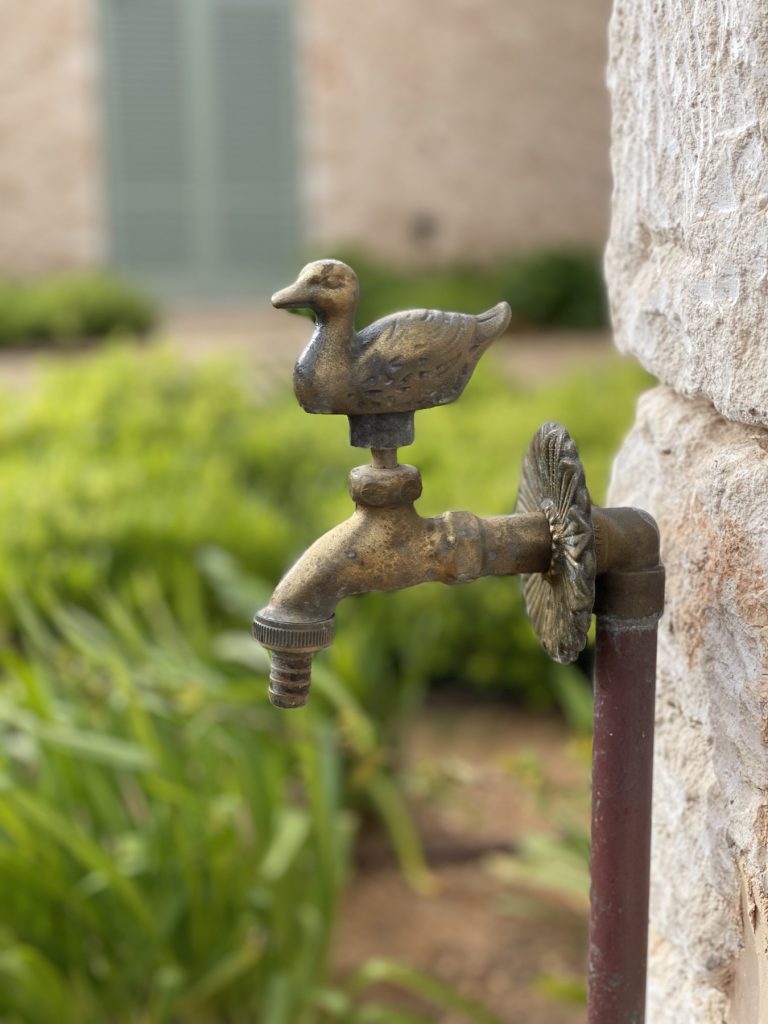
That some of them carry a small cast figure on the handle is something you notice only on the second look — and then every time after that. None of it is necessary. But it is exactly the kind of small thing that tells you whether a garden was designed or merely installed.
More about our work
Irrigation is one half of the answer; the planting is the other — see finca gardens and Mediterranean garden design. Completed work is in our projects.
Where the water in Mallorca actually stands — reserves, alert levels and what the town halls already prohibit — is set out with figures and a date under water and gardens in Mallorca.
How a garden is built to come through a Mallorcan summer on very little water — the planting, the lawn question and the ground cover — is set out under drought-tolerant gardens.
We work across the island. On particular areas: Santanyí and Andratx and Port d’Andratx.
We work across the island. On particular areas: Santanyí, Andratx and Port d’Andratx, Alaró and Artà.
Just bought a property here? See a garden for your new home in Mallorca — what to expect on water, permits and timing.
Have your system assessed
If your garden struggles through the summer, or if you are planning a new one and want the irrigation designed correctly from the start, we would be glad to come and look at what is needed.


