
© 2026 J&P DESIGN
Mallorcan Natural Stone in the Garden: Paths, Steps and Walls
A garden is made beautiful by its planting. But it is built out of stone. Paths, steps, walls and edges are the frame everything else is set against — and the only part still standing in February, when the grasses have been cut back and the perennials are waiting underground.
We work in natural stone: irregularly broken, in whatever thickness the job asks for, and in a tone that belongs to the walls of the house rather than arguing with them. No reconstituted concrete, no slab that is identical in every builders’ merchant in Europe.
Stone from Mallorcan quarries
Our material comes from quarries here on Mallorca. It is broken, not cast, not calibrated, not cut to size. Colour and format change from slab to slab, from delivery to delivery, sometimes within a single block: pale ochre through warm rose to veins of near-white quartz.
This is not a limitation to be put up with. It is the reason a finished path looks as though it had always been there. A manufactured slab repeats itself every forty centimetres — the eye picks up the pattern even without a name for it, and a surface made of such slabs reads as laid. Stone in which no two pieces are alike never repeats.
Anyone building in natural stone should know this beforehand: you will not get a finished surface that matches the sample. You will get a material that is alive. We choose every larger slab individually and lay it out on site before it is set — how the pale and dark stones are distributed is a design decision, not an accident.
And the distance is short. The stone does not cross Europe to end up in a garden surrounded by Mallorcan ground.
Paths
A path decides how a garden is entered. We lay ours in large, irregularly broken slabs bedded into compacted gravel, with the joints left wide enough for the planting to lean in from both sides. After two summers a path like this no longer looks laid. It looks found.
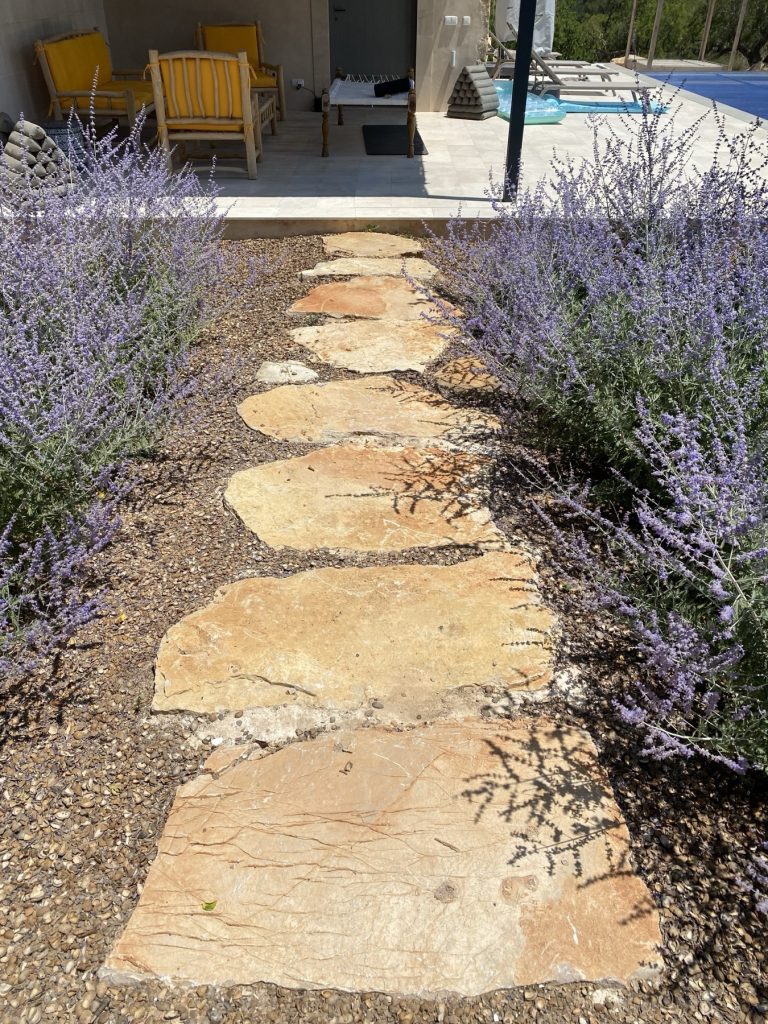
How tightly the slabs sit is a question of place. A path from the house to the pool, walked barefoot and in the dark, tolerates no gaps. A path through the planting can be single stepping stones with the ground left visible between them — it then does not only lead, it also slows you down.
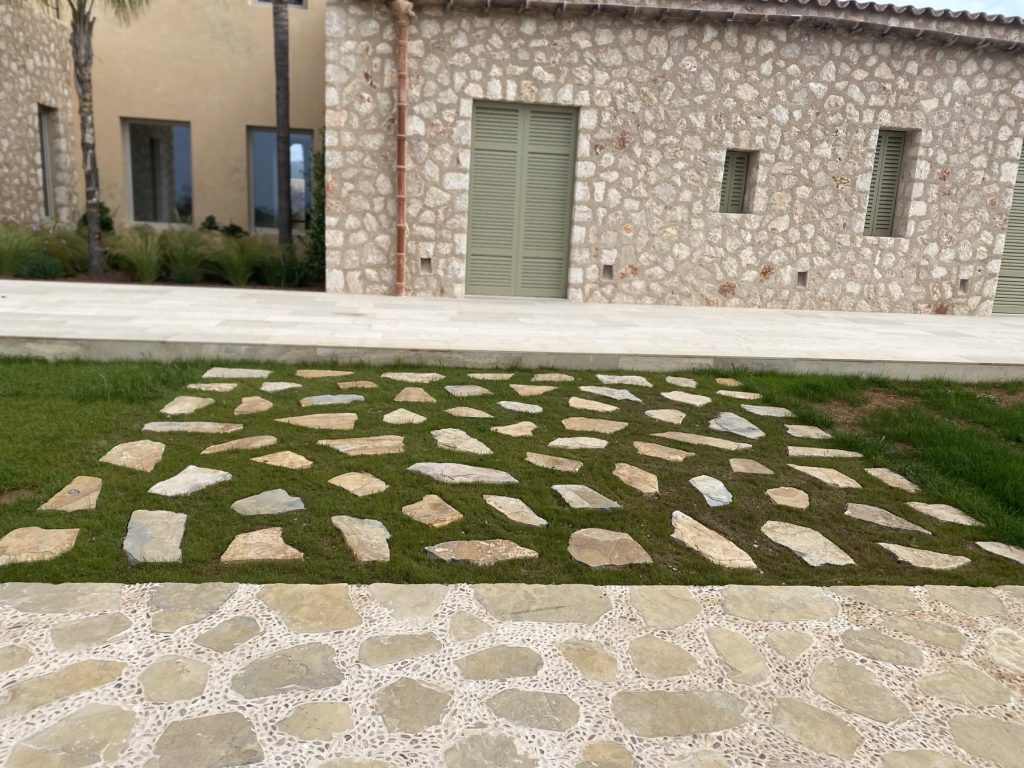
No concrete base — and, as a rule, no building licence
Here is a point that carries more weight in Mallorca than it would elsewhere. Our paths need no concrete base. The slabs sit on compacted ground, not on a poured slab.
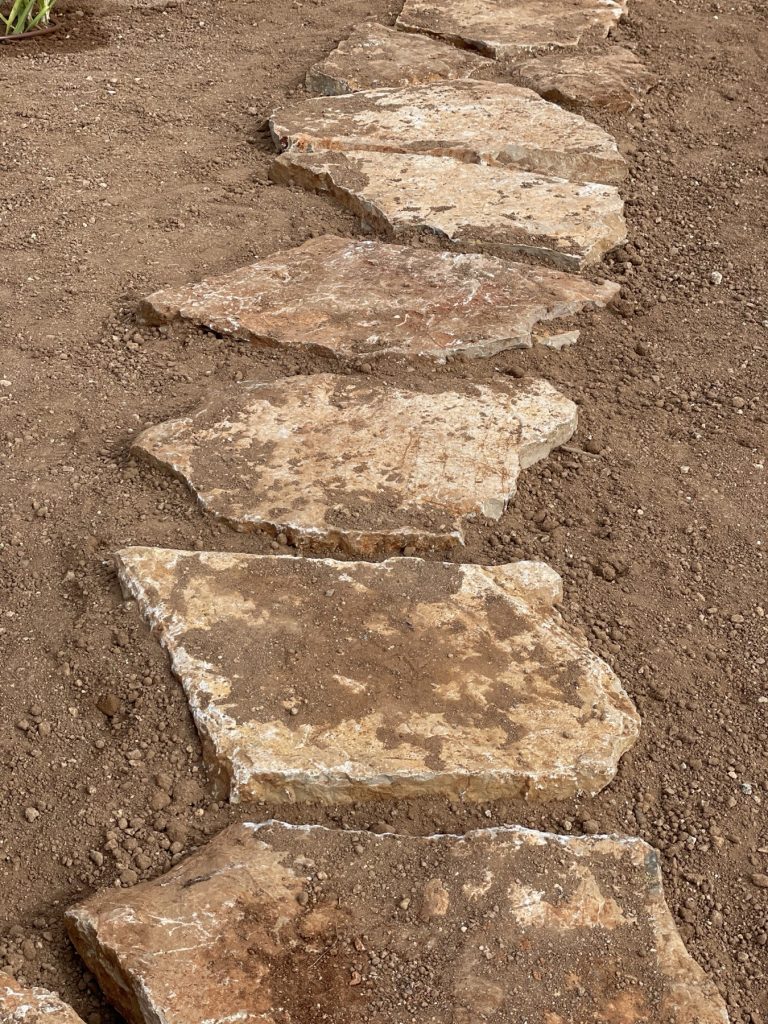
That has a consequence many owners discover only late: nothing is sealed, so nothing counts as built square metres — and as a rule no building licence is required. What any particular town hall asks for in a given case we establish beforehand, because the reading is not the same everywhere. In practice, though, that base is precisely what separates a garden path from a building project.
The second advantage is the ground itself. It stays permeable. Rainwater soaks in where it falls instead of running off at the edge and scouring the drive. In a summer where every litre counts, that is not a side issue either.
Steps and changes of level
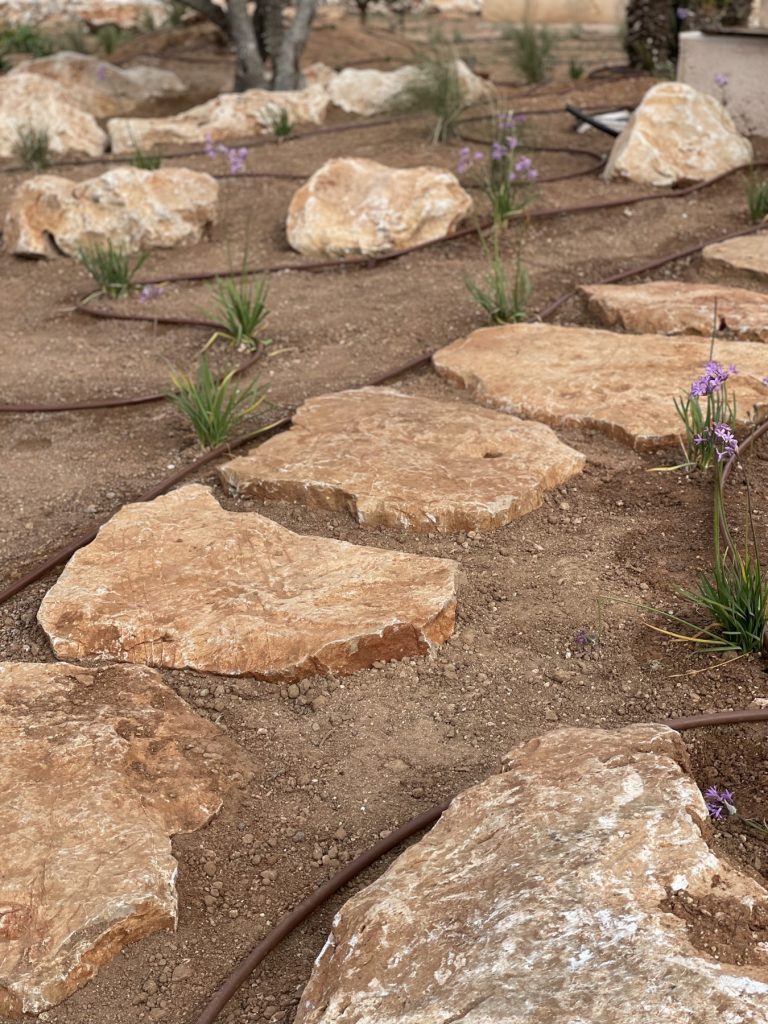
Mallorcan plots are rarely flat. Where a slope has to be taken, we set solid block steps — single stones heavy enough that nothing needs to hold them in place. They are not laid. They are set.
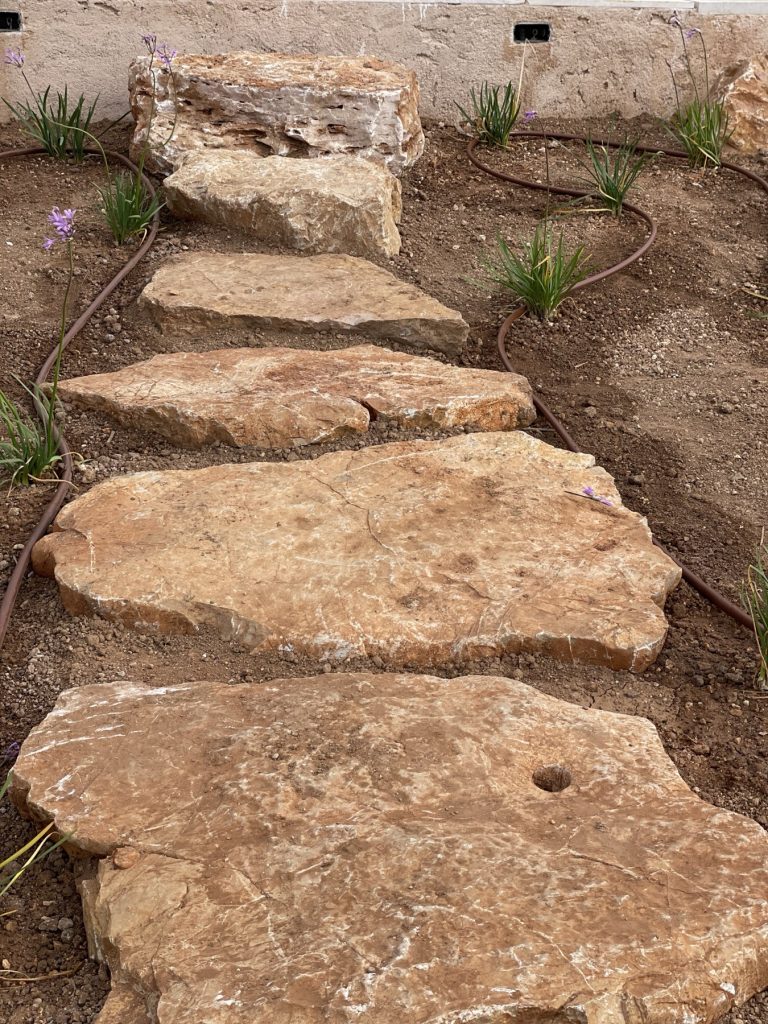
The appeal of steps like these is their irregularity. Each one is a different width, a different depth, a different break. You walk more slowly because you are looking — which is exactly what a garden ought to do to a person.
What grows in the joints
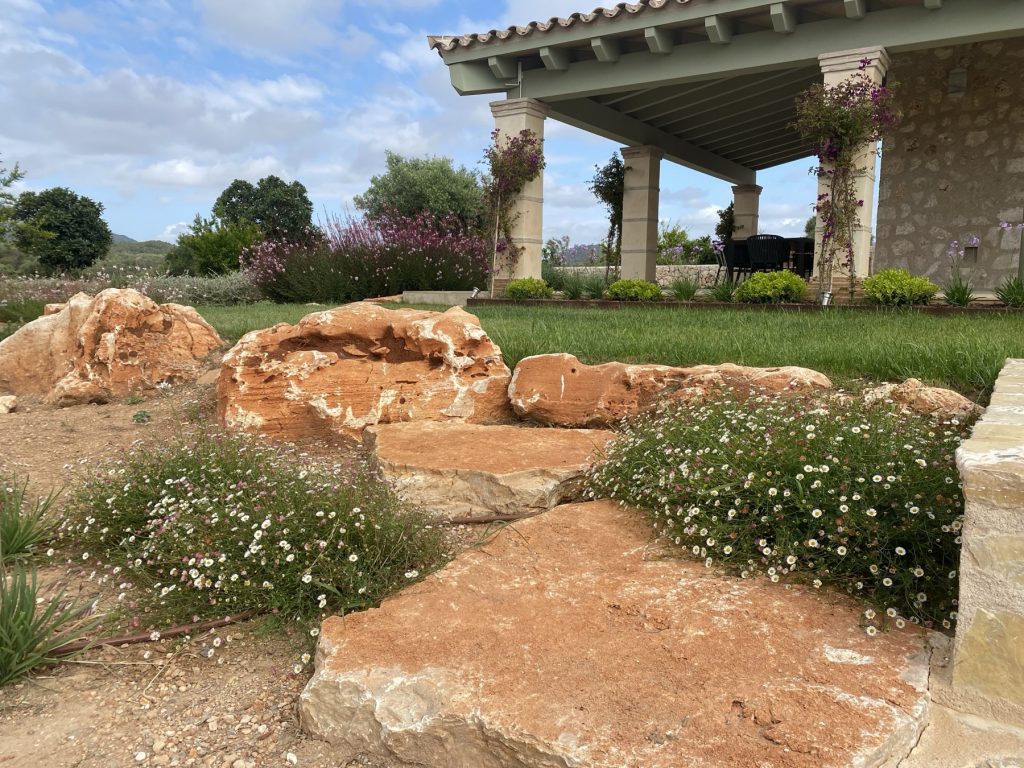
A joint is not a leftover gap. It is a place to plant. We leave ours open and fill them: Mexican fleabane, thyme, low hyssop. After one season the line between path and bed has disappeared, and the stone looks as though it had always been there.
Walls and terracing
The dry stone wall — in Mallorca the paret seca, recognised by UNESCO as intangible cultural heritage since 2018 — is the island’s oldest answer to a slope. It holds the ground, it stores warmth for the night, and it houses everything that lives between its stones.
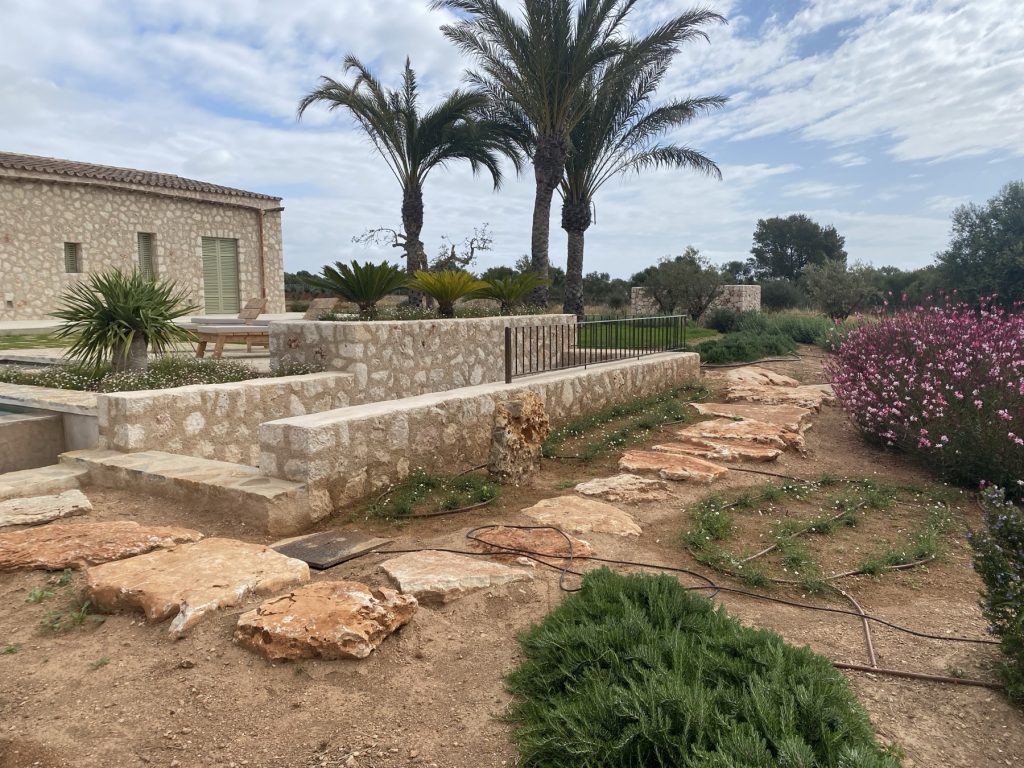
We use them where a plot has to be divided into usable levels, and we take our cue from what already stands nearby. A new wall should not announce itself. It should look as though it had merely been rebuilt.
How the stone ages
This is the real argument. Concrete goes grey, cracks, and looks tired after ten years. Natural stone does the opposite: it takes lichen, darkens in the joints, and wears smooth where people walk. It carries the years rather than being marked by them.
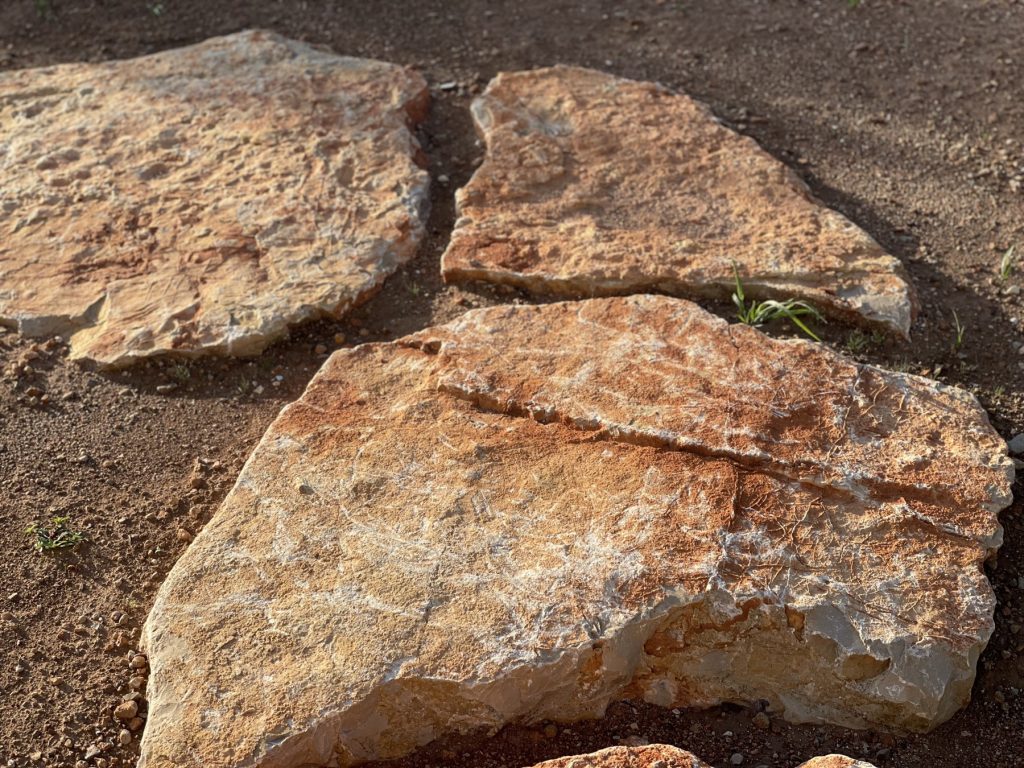
Then there is how it behaves in August. Local stone stays bearable underfoot long after dark concrete has become impossible to stand on — a difference you feel immediately at the edge of a pool.
What we take on
Design. Routes, levels, the position of steps and the thickness of the material, worked out together with the planting — not added afterwards as a surface over a finished garden.
Choosing the stone. We select the material and match colour and break to the house.
Execution. Base, laying, steps and walls by our own team.
The planting that goes with it. Joints, edges and transitions belong to the path, not to some later stage of work.
More about our work
Natural stone is part of almost every project we build. How it works alongside the planting can be seen on our pages for villa gardens, finca gardens and the Mediterranean garden. How we carry the planting through the summer on very little water is set out under irrigation.
Where the water in Mallorca actually stands — reserves, alert levels and what the town halls already prohibit — is set out with figures and a date under water and gardens in Mallorca.
How a garden is built to come through a Mallorcan summer on very little water — the planting, the lawn question and the ground cover — is set out under drought-tolerant gardens.
We work across the island. On particular areas: Santanyí and Andratx and Port d’Andratx.
We work across the island. On particular areas: Santanyí, Andratx and Port d’Andratx, Alaró and Artà.
Just bought a property here? See a garden for your new home in Mallorca — what to expect on water, permits and timing.
Let us look at your plot
If you are thinking about how the house, the terrace and the garden should be joined together, we will come and see the site and tell you what is possible there. J&P Design, based in Santanyí in the south-east of Mallorca since 2008.


