
© 2026 J&P DESIGN
Mediterranean Garden Design in Mallorca
A Mediterranean garden is not a style. It is a way of reading a place.
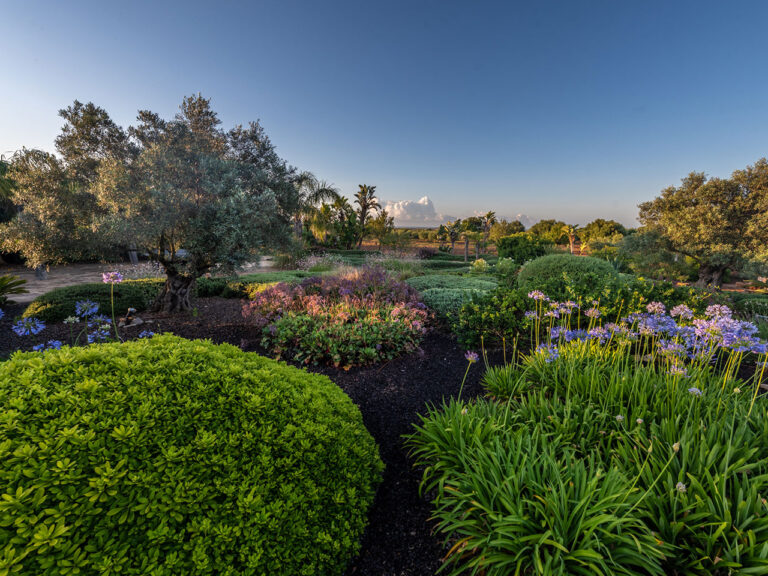
The term gets used loosely. A garden with terracotta pots and a lavender border is not a Mediterranean garden — it is a northern European idea of one. A true Mediterranean garden in Mallorca is composed around the local climate, the local soil and the local flora, and around the particular conditions of the ground it occupies.
We have been making these gardens since 2008. Our approach is shaped by the naturalistic planting movement — Piet Oudolf, Tom Stuart-Smith, the Dutch Wave — translated to the conditions of this island. The result is a garden that appears to have emerged from the site rather than to have been placed upon it.
What defines a Mediterranean garden
Drought tolerance as a design principle. Every plant in the scheme comes through a Mallorcan summer once established. That is not a constraint. It defines the palette and gives the garden its character.
Naturalistic structure. Plants are set in drifts and communities, as they grow in the wild — taller structural planting emerging from lower ground cover, with interest that moves through the year rather than peaking in a single moment.
Local and endemic species as the backbone. Cistus, rosemary, lentisc, wild thyme, euphorbia and the ornamental grasses are the plants that define this landscape. We use them as structure, not as a gesture towards local character.
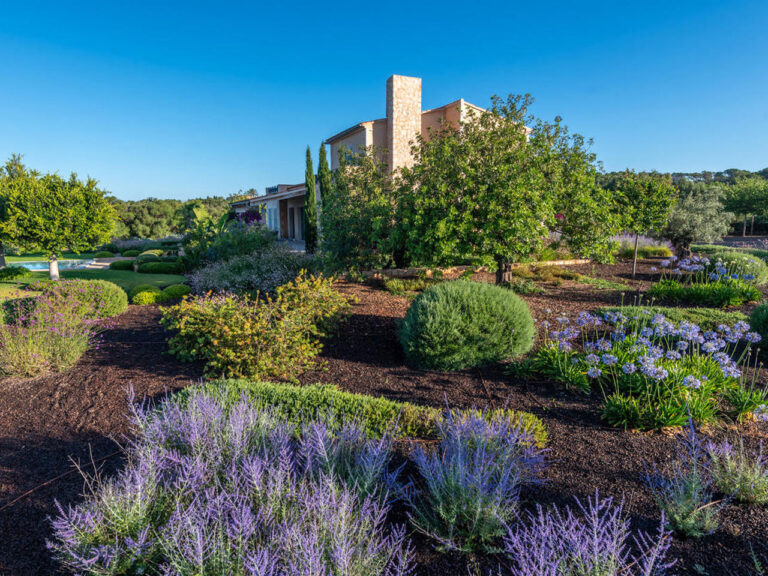
Hard landscape in local materials. Marès stone, limestone, natural gravel in Mallorcan tones. Materials that have always belonged here and that improve with age under this sun.
A permeable edge. In a rural setting especially, the boundary between garden and landscape should be a gradual transition rather than a line — from designed planting, through managed vegetation, into open country.
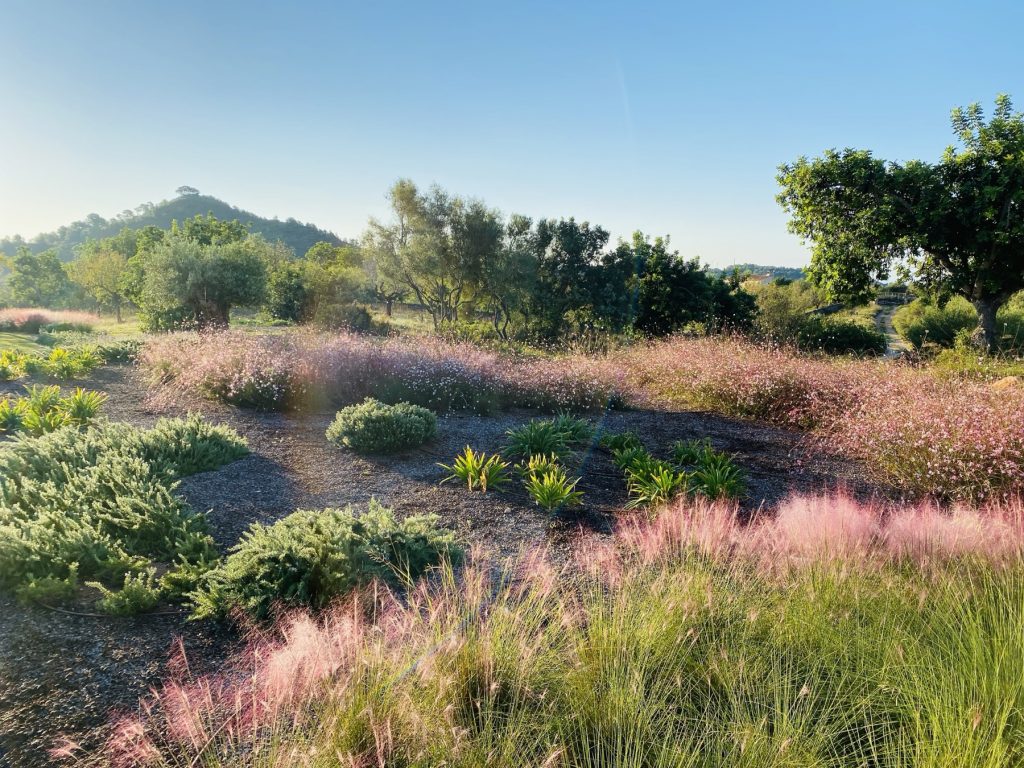
The naturalistic approach
Rather than designing a garden as a fixed composition to be held in that state, we design one that develops: that self-seeds, that allows volunteers, that answers the seasons in a way a conventional scheme cannot.
In Mallorca this has particular force. The wild garrigue of the island — the cistus scrub, the rosemary hills, the grass meadows of the south — is already a naturalistic composition of remarkable beauty. A well-made Mediterranean garden draws on it and refines it rather than replacing it with something foreign.
We work with Stipa tenuissima for movement and light, Perovskia atriplicifolia for late colour, Gaura lindheimeri for airiness, and the salvias for structure and pollinators — alongside the native cistus, rosemary and lavender that define this landscape.
A garden that improves rather than ages
Everything else about a house begins to age the day it is finished. A garden of this kind does the opposite. The olives thicken, the walls weather, the planting closes and settles until it reads as though it had always been there.
That is what makes it part of the property rather than a cost against it — and it is why we design for permanence rather than for a photograph taken in the first season.
For different kinds of property
Villa gardens. The Mediterranean approach suits a house used for part of the year particularly well. A naturalistic scheme with intelligent irrigation carries itself through the summer without daily attention.
Finca gardens. The rural setting demands it. A garden that ignores the rosemary hills, the olive groves and the garrigue around it will always look imported. One that draws on them feels inevitable.
Coastal properties. Salt-tolerant planting matters near the sea, where spray removes a large part of the conventional garden palette. Cistus, lentisc, rosemary and the ornamental grasses take coastal exposure well.
Almond shell rather than imported bark
Over the drip lines we lay almond shell rather than imported bark mulch — a by-product of Mallorcan agriculture that this island produces in quantity every season.
The layer holds moisture in the soil instead of losing it to the afternoon sun, so the same volume of water goes considerably further. It keeps the ground cooler, which matters to roots in August. And it suppresses the weeds that would otherwise compete for exactly that water.
What matters most is something many coverings fail to do: almond shell lets the soil breathe. Its coarse, open structure allows air and water through instead of compacting. A pressed mulch blanket — or worse, a plastic membrane beneath it — suffocates the ground; the roots get no oxygen, and what was intended as protection becomes the problem. A natural material that holds moisture and still stays permeable is not easy to find.
And then the part one does not expect: almond shell makes the planting look better. Its warm, neutral tone works like the mount around a picture — the silver-grey of the rosemary, the mauve of the perovskia, the pink of the grasses all read more strongly against it. On bare earth or dark bark, the same colours lose their force.
It also belongs here. Its colour and grain settle into a Mallorcan landscape in a way that imported northern European bark never does.
More about our work
See our wider approach to garden and landscape design in Mallorca, the technical side in irrigation systems, or completed work in our projects.
Paths, steps and walls are the frame the planting is set against. What we build them from — and why a garden path as a rule needs no building licence — is set out under Mallorcan natural stone in the garden.
Where the water in Mallorca actually stands — reserves, alert levels and what the town halls already prohibit — is set out with figures and a date under water and gardens in Mallorca.
How a garden is built to come through a Mallorcan summer on very little water — the planting, the lawn question and the ground cover — is set out under drought-tolerant gardens.
We work across the island. On particular areas: Santanyí and Andratx and Port d’Andratx.
We work across the island. On particular areas: Santanyí, Andratx and Port d’Andratx, Alaró and Artà.
Just bought a property here? See a garden for your new home in Mallorca — what to expect on water, permits and timing.
A conversation on your land
Every Mediterranean garden begins with understanding the specific site — its orientation, its soil, its existing vegetation, its relationship with the country around it. We would like to see yours.


